
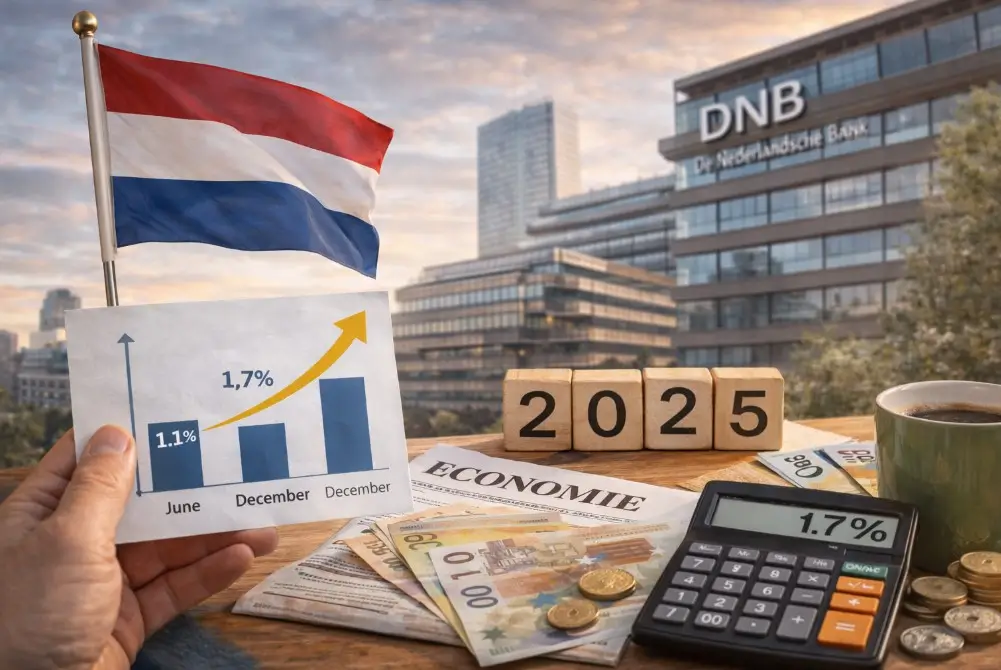
The Dutch economy is demonstrating considerably more resilience than previously anticipated, prompting De Nederlandsche Bank (DNB) to revise its growth projections for 2025 upward. In its latest Autumn Projections, published on December 19, 2025, the central bank now estimates economic growth at 1.7% for the year. This represents a substantial increase from the 1.1% forecast issued just months ago in June.
While global trade uncertainties remain a concern, the immediate impact on the Netherlands has been less severe than feared. A combination of increased government spending and a strategic acceleration in international trade has provided a temporary boost to the national GDP. However, the DNB warns that while the current figures are positive, structural challenges and long-term fiscal discipline remain critical issues for the incoming cabinet.
Trade Acceleration and Government Spending Drive Growth
The unexpected surge in economic activity is largely attributed to specific behavioral responses from the corporate sector regarding international trade policies. Despite the looming threat of higher American trade tariffs, global trade volume has increased in 2025. This counter-intuitive result is partly due to companies anticipating these tariffs and rushing to move goods across borders before new levies take effect.
This “front-loading” of trade has acted as an adrenaline shot for the open Dutch economy. DNB President Olaf Sleijpen noted the resilience of the economy, highlighting how businesses have actively navigated the changing geopolitical landscape. However, this effect may be temporary. The forecasts for subsequent years show a moderation in growth, with projections set at 1.2% for 2026 and 1.1% for 2027. While these figures are lower than the 2025 spike, the outlook for 2026 is still more positive than earlier spring estimates suggested.
In addition to trade dynamics, domestic government expenditure has played a pivotal role. Employment within the public sector has grown faster than expected, contributing directly to GDP expansion. While this supports current growth figures, it also raises questions regarding the sustainability of public finances.
Inflation Trends and Household Purchasing Power
Inflation in the Netherlands is on a downward trajectory, though it remains persistent relative to neighboring economies. The DNB projects inflation to fall from 3.0% this year to 2.4% in 2026 and further to 2.3% in 2027. Despite this decline, Dutch inflation rates continue to hover above the average for the Eurozone, although the gap is gradually narrowing.
For households, the economic picture is improving in terms of income. Wages are currently rising faster than inflation, resulting in an increase in real income. This boost in purchasing power is supporting private consumption, which remains a key pillar of economic stability. However, consumer behavior is shifting. Households are expected to maintain high savings rates in the coming years, often prioritizing financial security or saving for homeownership over immediate discretionary spending.
Housing Market Pressures Persist
The housing market continues to be a source of significant financial pressure. House prices are projected to rise by 8.5% in 2025. While the rate of increase is expected to level off in subsequent years, price growth will likely continue to outpace income growth. This dynamic forces many households to save aggressively to enter the market or reduce existing debts.
For those looking to enter the property market, the environment remains challenging. Understanding the landscape of mortgage loans in the Netherlands is becoming increasingly complex as prices climb. The disparity between income growth and asset price inflation suggests that housing affordability will remain a central political and economic issue.
Fiscal Concerns and Structural Bottlenecks
While the economy grows, the government’s budgetary position is deteriorating. The budget deficit is expected to widen from 1.9% of GDP this year to 2.9% next year. Although this remains just within the European Union’s 3% limit, the DNB characterizes the current fiscal policy as too expansive given the state of the economy. Increased government spending is fueling demand, which in turn contributes to the relatively high inflation rates seen domestically.
Furthermore, the national debt is on an upward trajectory. The debt-to-GDP ratio is forecast to rise from 45.2% in 2025 to 48.2% by 2027. The central bank advises that structural government expenses should be covered by structural revenue sources to prevent long-term imbalances.
The Cost of Infrastructure Limitations
The Autumn Projections also include a scenario analysis focusing on structural bottlenecks, such as the overloaded electricity grid and nitrogen emission restrictions. These physical and regulatory barriers are currently hindering potential growth. If the government were to successfully address these issues, the economic outlook could improve further.
In a scenario where these bottlenecks are resolved, business confidence would likely surge, leading to higher investment levels. This would be particularly relevant for companies seeking business loans in the Netherlands to expand operations or upgrade sustainability infrastructure. The DNB estimates that tackling these structural issues could boost GDP growth to 1.6% in both 2026 and 2027—approximately 0.4 percentage points higher per year than the baseline forecast—without significantly impacting inflation.
Recommendations for Policy Makers
The DNB concludes its report with urgent advice for the government. The primary recommendation is to decisively address the barriers limiting the Netherlands’ growth potential. Uncertainty regarding government policy, combined with physical constraints like the power grid, discourages investment. A stable environment is essential for businesses to plan for the future.
Secondly, the central bank urges a stronger focus on European competitiveness. While plans exist to strengthen the EU internal market and capital union, execution has been lagging. The DNB calls for decisive action that transcends national interests to improve the collective economic standing of the bloc.
Finally, fiscal prudence is emphasized. The current expansive budget policy is stimulating demand in an economy that is already running at capacity, thereby keeping inflation higher than necessary. With an aging population and future challenges on the horizon, the DNB advises that the government must reform sensitive schemes and ensure the tax system is future-proof. Managing the broader spectrum of loans in the Netherlands, both public and private, will require a disciplined approach to prevent overheating the economy while maintaining necessary social services.